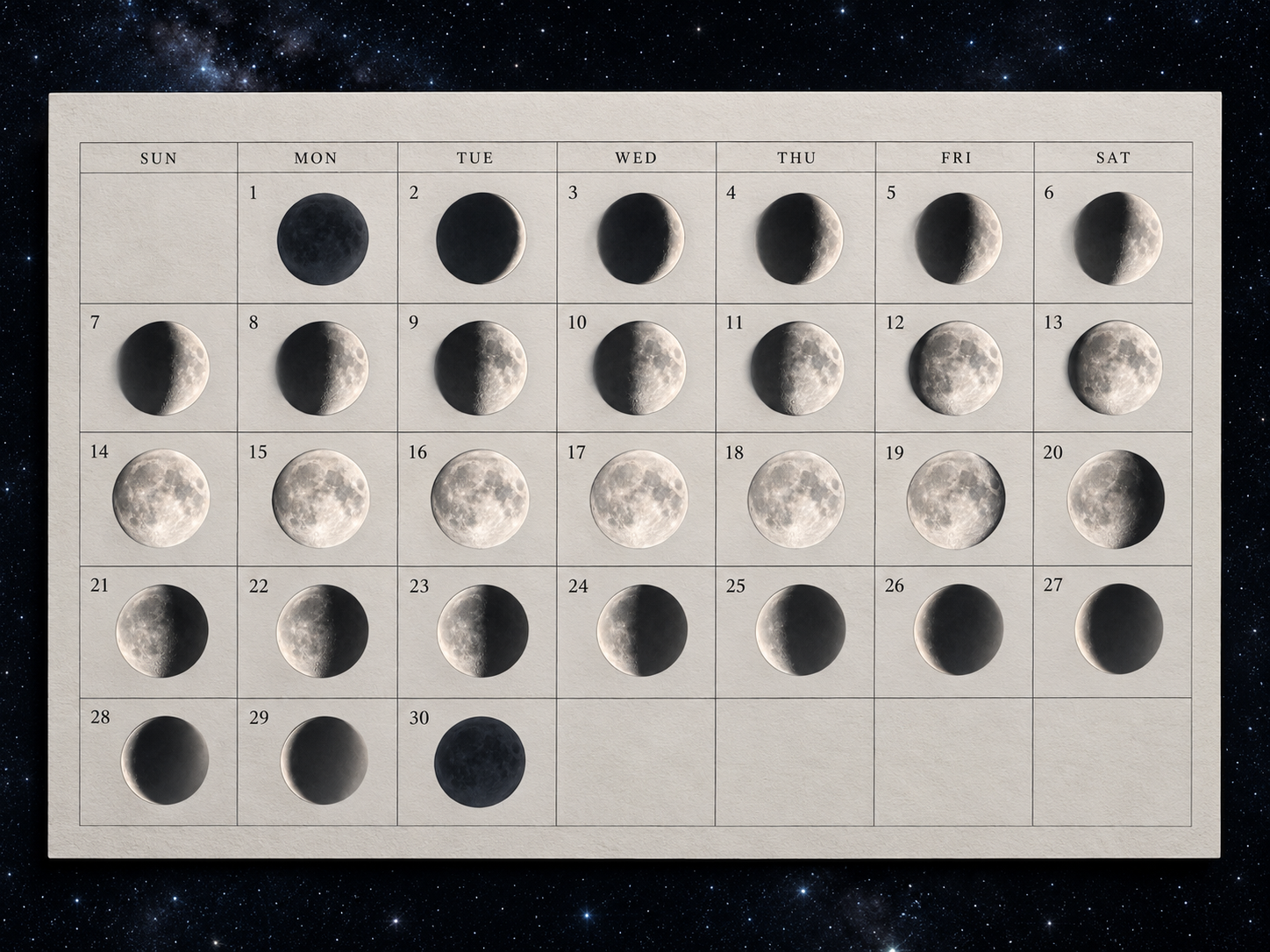
Your Guide to Every Phase, Any Month Past or Future
A moon phase calendar shows the shape of the moon for every day of a month, letting you see at a glance when the new, first quarter, full, and last quarter phases fall — and how the moon grows and shrinks between them. In the Southern Hemisphere? The moon pictures in this calendar automatically flip to match the sky you see, and you can switch views with the "Viewing from" toggle below the calendar.
Monthly Moon Phase Calendar
Phases are computed from the synodic month for each calendar day at local noon.
Moon image: NASA/GSFC/Arizona State University.
Learn more about moon phase calendarsFree 2027 Moon Calendar
Download a free printable 2027 moon phase calendar poster. Every phase of the Moon for every day of the year, in a landscape print-ready PDF or PNG — yours to keep, no sign-up. Full moons wear a thin gold ring and new moons a thin outline so you can spot them at a glance.
Choose and preview your version
What a moon phase calendar shows
A moon phase calendar is a grid — usually laid out like a regular monthly calendar — where each day is marked with a small icon representing the moon's appearance that night. Watching the icons flow across the weeks reveals the steady rhythm of the lunar cycle: a dark new moon, a growing crescent, a half-lit quarter, a bulging gibbous, a bright full moon, and then the whole sequence in reverse.
Because the four major phases (new, first quarter, full, last quarter) each occur at a precise instant, a calendar will often highlight the exact date and even the time when the moon reaches that moment. The days in between are the intermediate phases — waxing crescent, waxing gibbous, waning gibbous, and waning crescent — which make up most of the month.
Why the phases don't line up with calendar months
The lunar cycle — the time from one new moon to the next — is about 29.5 days. Our calendar months are between 28 and 31 days long, and they do not divide evenly by 29.5. As a result, the moon phases drift earlier by roughly one day each successive month, and a given phase (say, the full moon) can fall on a different date every month and a different date each year.
This is also why a lunar calendar and a solar calendar diverge over time. A year of 12 lunar months is about 354 days, roughly 11 days short of the 365-day solar year. Calendars that follow the moon, such as the Islamic calendar, use moon sighting to mark months and shift through the seasons over the years.
A good moon phase calendar accounts for this drift by computing each day's phase from the actual astronomical position of the moon rather than repeating a fixed pattern. That is how the live calendar on Track the Moon works: every day's icon is calculated from the moon's position, not copied from a template.
How to read and use a moon phase calendar
Start by locating the four major phases for the month. The new moon tells you when the sky will be darkest and best for stargazing. The full moon tells you when the moon will be brightest and visible all night. The first and last quarter moons rise and set at opposite times, each showing a half-illuminated disc that is excellent for observing surface detail along the terminator — the line between light and dark.
From there, read the waxing (growing) phases between new and full, and the waning (shrinking) phases between full and the next new moon. The icons let you plan ahead: schedule a night hike under a bright waxing gibbous, plan astrophotography around the new moon, or time a moonrise photo for the full moon.
- New moon: darkest skies, best for deep-sky stargazing and astrophotography.
- First quarter: moon rises around noon and sets around midnight; great evening viewing with crisp terminator detail.
- Full moon: rises near sunset, visible all night; brightest but washes out faint stars.
- Last quarter: rises around midnight and sets around noon; ideal for early-morning moon observation.
Planning with the calendar
A moon phase calendar is a planning tool as much as an astronomical one. Photographers use it to line up moonrise and moonset with golden hour. Gardeners who follow lunar traditions time planting by it. Fishers and coastal visitors use the new and full moon dates to anticipate the strongest spring tides. And anyone who simply enjoys the night sky uses it to pick the best evenings to look up.
The most useful calendars pair the phase icons with moonrise and moonset times for your location, since a phase is only visible if the moon is above your horizon. Combining the phase with its rise and set times tells you not just what the moon will look like, but when and where to find it.
Explore related moon tools
Turn the calendar into better lunar photos with our Photographing the Moon guide.
The Moon Phases in Order
Every lunar month, the Moon moves through the same eight phases in order, taking about 29.5 days to complete the cycle. Here’s how to read them on a moon phase chart, from one new moon to the next. Tap any phase to learn what it means.
Waxing means the lit part is growing, heading toward full. Waning means it’s shrinking, heading back toward new. On a lunar calendar chart, the full moon and new moon fall about two weeks apart, with the quarter moons halfway between them.
Frequently Asked Questions
How accurate is a moon phase calendar?+
When phases are calculated from the moon's actual astronomical position, a calendar is accurate to within a fraction of a day. The exact instant of each major phase is precise; the daily icons represent the moon's appearance around local noon on that date.
Why does the full moon fall on a different date each month?+
Because the 29.5-day lunar cycle does not match our 28–31 day calendar months. Each month the phases shift about one day earlier relative to the calendar, so the full moon lands on a new date.
What is the difference between waxing and waning?+
Waxing means the illuminated portion of the moon is growing, from new moon toward full moon. Waning means it is shrinking, from full moon back toward the next new moon. In the northern hemisphere, the lit side grows from the right during waxing and shrinks from the right during waning.
Can a moon phase calendar predict eclipses?+
It can show you when eclipses are possible. Solar eclipses happen only at the new moon and lunar eclipses only at the full moon, so those dates are the ones to watch. Whether an eclipse actually occurs depends on the precise orbital alignment, which a basic phase calendar does not show.
What are the moon phases in order?+
The eight moon phases in order are: New Moon, Waxing Crescent, First Quarter, Waxing Gibbous, Full Moon, Waning Gibbous, Last Quarter, and Waning Crescent. Then the cycle starts again with the next New Moon.
What is a lunar calendar?+
A lunar calendar is a calendar based on the Moon's cycle of phases instead of the Sun. Each lunar month runs from one new moon to the next. Many cultures still use lunar calendars for holidays and festivals, and a moon phase calendar like this one shows those phases day by day.
How long does it take the Moon to go through all its phases?+
About 29.5 days. That's why there's usually one full moon a month, and occasionally two, which is called a Blue Moon.
Can I see a moon calendar for a different month or year?+
Yes. Use the arrows on the calendar to move between months, or browse monthly moon phase calendars from 2016 through 2036.
Keep exploring the moon